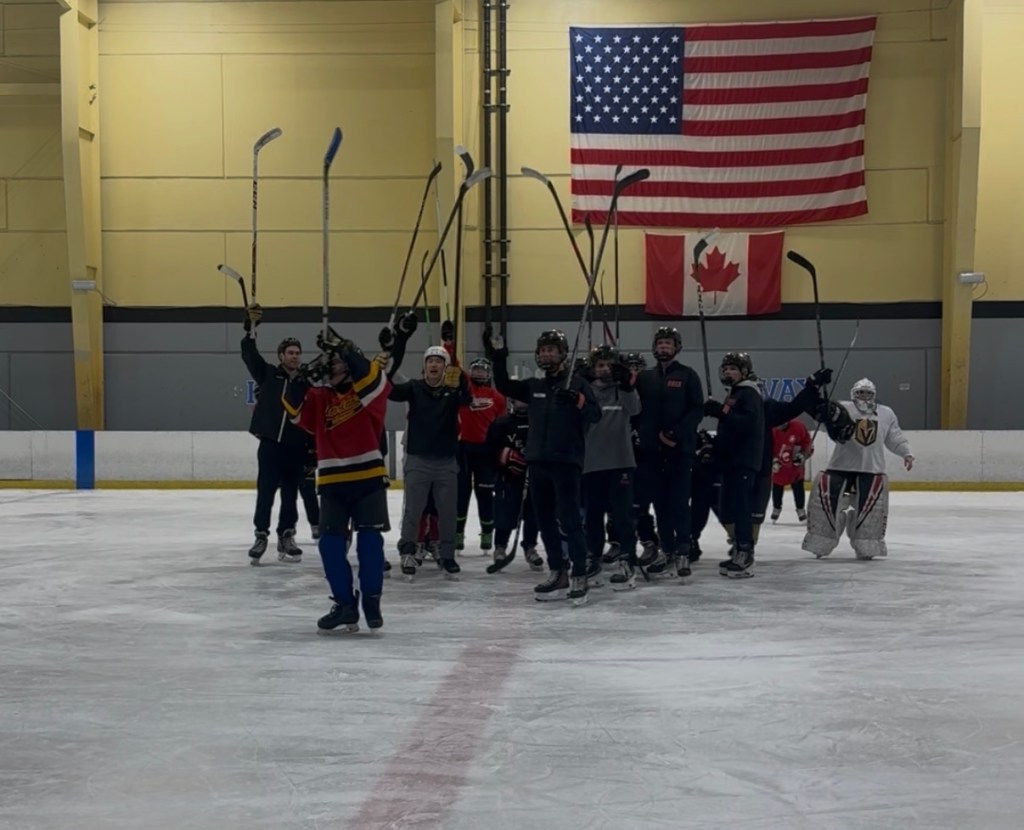
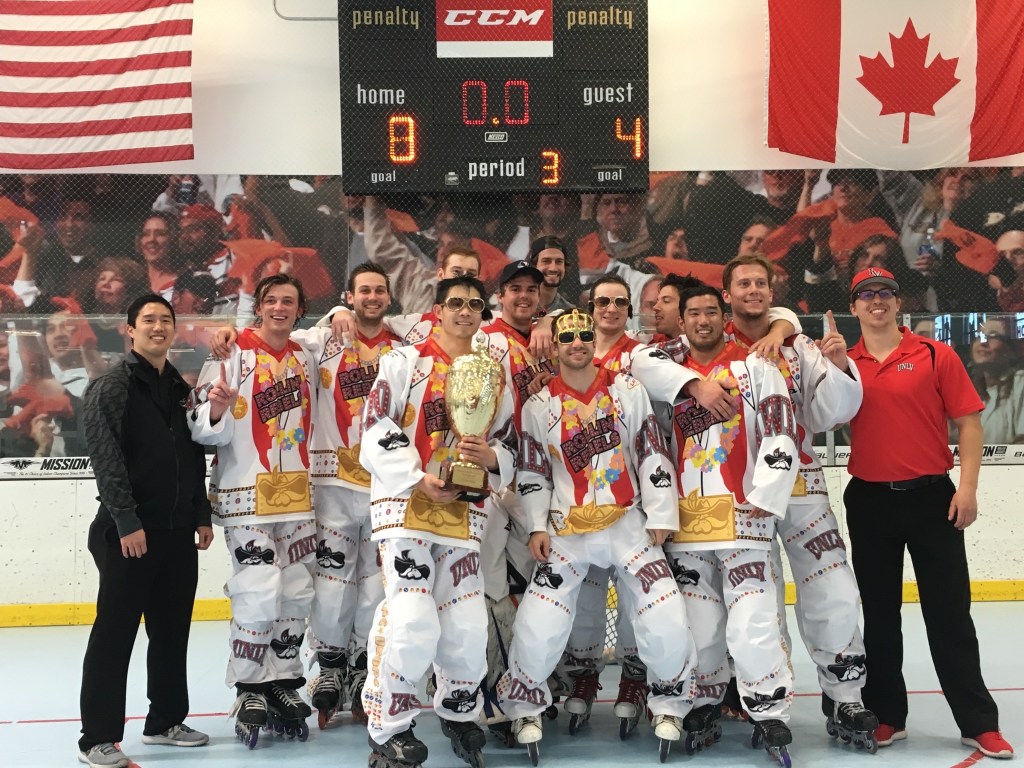
Hockey has been a part of Adam Tamura’s life since he was eight years old. Starting with travel roller hockey as a child, he went on to play defense for both the Centennial High School team and the University of Las Vegas Rebels. Since then, he has continued to play on club and recreational teams. Adam can barely remember a moment of his life when he wasn’t on skates. And if he wasn’t on the rink, he was next to it: coaching.
“I started coaching when I was 17,” Adam told me. “One of the coaches on my brother’s travel hockey league had to drop out, so I jumped in to help. Ever since then, I’ve been coaching here and there.”
With Adam as coach, the UNLV Rebels Roller Hockey team made it to the National Collegiate Roller Hockey Association Final Four multiple times.
In 2025, a friend of Adam’s suggested he look into the Vegas Golden Chariot Special Hockey team—a recreational ice hockey league for special needs children and adults.
What is now the Vegas Golden Chariot Special Hockey team began seven years ago as Spectrum on Ice. In 2025, the funding and management of the team changed. They began a partnership with the Las Vegas NHL team, the Golden Knights, who provide grants to cover ice time for practices. There are now two teams under the umbrella of the Vegas Golden Chariots program: a sled hockey team for players with physical disabilities and the team that was formerly Spectrum on Ice, specifically for neurodivergent players. This new association with the NHL required a different kind of management and coaching structure—which is why the Golden Chariot board needed to recruit a more experienced, serious coach.
Like Adam.
Though he was flattered to be asked, Adam was hesitant at first. “I hadn’t coached ice hockey before, but that wasn’t my main concern,” Adam reflected. “I had no experience coaching people with special needs, and I really wasn’t sure I would be good at it.”
Adam’s friend told him that coaching this team would change his perspective on hockey. “That intrigued me because I thought I already had a pretty broad perspective on the sport.”
Adam’s curiosity led him to go meet with the Vegas Golden Chariot Board of Directors, which is made up entirely of players’ parents. With his thick resume of playing and coaching, the board thought he would be an excellent fit. So Adam agreed he would give it a try.
What Adam witnessed on his first visit to meet the players and watch their practice was alarming. All the players were wearing the same color jersey and all chasing one puck toward one goal. “It was chaotic,” Adam said. “Afterwards, I asked one of the board members if this was what their practices usually looked like, and they said yes. I told them I could at least guarantee better practices than that, with actual drills and lessons. I still had some misgivings about how capable I would be as a coach with this population, but I knew they deserved better opportunities to play than what they were being given.”
After officially accepting the head coach role, one of the first things Adam did was call his cousin in California, a primary grades special education teacher. “I immediately phoned her, mildly panicked,” Adam recounted. “She gave me a bunch of tips and ideas on how to address different players. We also talked a lot about strategies to manage specific needs and disabilities. She warned me that breakdowns were likely with this population, but she gave me some helpful guidance on how to manage and support the players if that occurred. Honestly, I probably prepared more than I needed to, but I wanted to ensure that these players were receiving the right kind of support and direction from their coach.”
So Adam formulated his first practice—separating the players into groups and running some typical drills. “It was a total failure,” Adam said. “I was really discouraged and thought it was too hectic and one of the worst practices I had ever coached. But afterwards, several parents came up to me, thanking me effusively. They told me that it was the best practice they had ever seen. They saw their kids engaged in a way that they hadn’t before, and I realized that my expectations had been all wrong. What seemed hectic to me was actually the most organized practice these players had ever received.”
This moment brought to mind another piece of advice Adam’s cousin had given him. “She said that the first thing is to give yourself grace,” Adam remembered. “She told me that I should allow myself to fail, and that’s very hard for me personally—it was something I needed to get more comfortable with because I tend to be a perfectionist. But she reminded me that there wasn’t going to be a uniform idea of success here because my past experiences and the experiences of this community differ so greatly. So the ways that I measure success may not be the same as how these players and parents measure it and that’s okay.”
Holding all of this feedback close, Adam continued to develop practices for his new team. One thing Adam has done to strengthen the experience for these players is recruit hockey player friends as well as his own dad to jump in as assistant coaches. With additional coaches, the players can get more individual and small group attention which greatly increases their likelihood of successful learning.
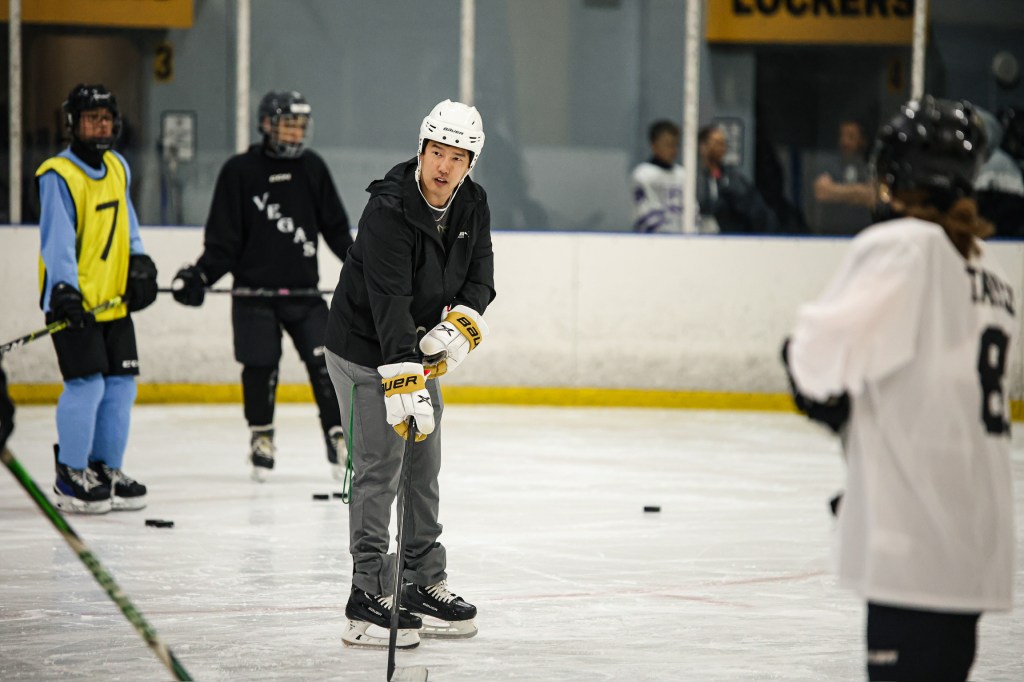
“I’m not coaching special needs players, I’m just coaching hockey players,” Adam mused. “That’s why it’s really important to me that I don’t refer to them as ‘kids’ but as ‘players’ or ‘athletes.’ Not only because the age range of this team goes from eight to 38 but also because these players are just players. Sure, they may have different ways of processing things than you or I do, but they also deserve the same opportunities to play on a team, learn a skill, or rejoice in the feeling of a win like you or I do. Really accepting this viewpoint changed the entire way I approach things. I don’t coach them differently than I would coach any one of my other teams.”
When Adam and I talked, he broke down the way that he is approaching practices now: he divides the players into three small groups, focused on skill. With the most advanced group, Adam has found he can teach these players specific skill sets, and with the less advanced groups, he focuses on making the drills fun and positive. He has also seen the benefit of grouping the players this way because it gives them the opportunity to “graduate” to a higher group once their skills progress.
“We had these younger, smaller players that were more intimidated so I separated the groups, and that magically turned into something fascinating,” Adam told me. “Now all of a sudden, peers are with peers and skill levels have matched up. I find that it allows them to succeed in their own right; so many of these players have never seen success simply due to the environment they have been forced to play in.”
I listened to Adam explain all this, nodding and smiling slyly. “You know,” I chimed in, “in the teaching field we have a word for what you’re doing. Do you know it?”
“No! What is it?” Adam inquired.
“Differentiation,” I responded.
I told Adam what differentiation means: developing lessons and activities to suit varied needs, interests, or skill levels. This can look like dividing students into different groups to provide varying levels of materials; organizing centers and tasks that students can choose based on what their learning styles are; pulling students out for one-on-one instruction; or providing students with specific needs the access to tools that help them succeed.
“This is exactly what you’re doing on the ice, isn’t it?” I asked him.
“Yeah, I suppose it is. Cool!” We shared a laugh.
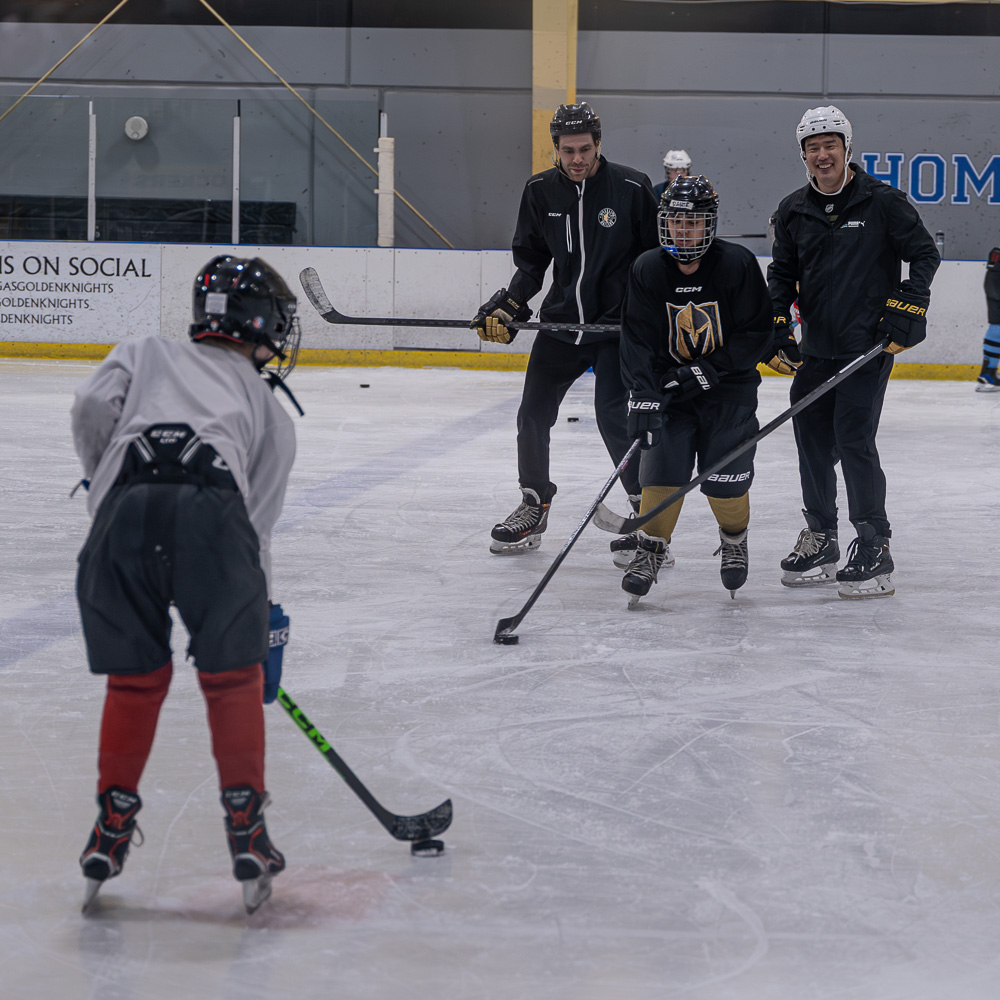
An essential part of Adam’s coaching model is championing positivity. He told me that he doesn’t criticize the players, though he may gently correct action to ensure the athletes are performing drills correctly. It is important to him that he and his fellow coaches highlight success in every circumstance. “It doesn’t matter if they shoot it into an open net, it doesn’t matter if they shoot it wide—we celebrate how hard they shot it,” Adam told me. “If they make a turn without falling, I’ll yell ‘hey, way to skate hard!’ I always try to bring positive energy no matter what. So many of these players have never received that, especially in a social environment.”
Adam emphasized the fact that they are not just teaching hockey skills but helping these players learn social and emotional skills, as well—something that this group of athletes has not had ample opportunity to learn until now.
“Some of the things we’re working on are spatial awareness, conceptualizing team strategy, and sportsmanship,” Adam said. “Lately, we’ve been talking a lot about how to be a good teammate and how to encourage one another. We have been modeling what that looks like and prompting them to show support, however they can. We have two players who are nonverbal. One of these players kept scoring during a recent drill, and I just started yelling at the top of my lungs about how awesome he was. He has blossomed with this kind of encouragement. We also have some teenage players who have never been part of a team before—they have always been the ‘weird kids’ at school and tend to get picked on. Now, they are one of many of their peers, and they are experiencing camaraderie. All these athletes are accelerating so much further than I expected, and I think a lot of that is due to the social lessons and comfortable environment in addition to the practical hockey skills they are learning.”
Adam told me about one of his players who has severe motor limitations and who, until very recently, was not able to stay on the ice without holding onto the wall the whole time. Adam’s father has been working one-on-one with this player, and one of the first things he did was take him out onto the ice in a sled chair, enabling him to get the feel of the open ice for the first time. He felt the air on his face and the adrenaline rush of speed and movement; since then, he has not needed the wall during practice. Though he still needs one-on-one instruction, he is experiencing a kind of freedom that he never has before.
This same player also picked up a time-honored tradition from Adam and the other coaches, which they didn’t even realize they were teaching him: the high-five. “It’s just something I do—put my hand up after practices for high-fives,” Adam recounted. “One day, he started mimicking me by putting his hand up in the air and of course, we would give him a high-five. His parents told me later that apparently he has started doing this whenever they are out and about, too. It was a totally unintended side effect but it’s great to see that he’s been learning that other people can be safe, and that it’s okay to socially interact, even with strangers.”
There are so many stories about the incredible players that Adam is working with and what they have been accomplishing. He told me about a player who had never gotten through previous practices without meltdowns, but under Adam’s coaching has now gone ten practices in a row cool as a cucumber. He detailed another player’s journey: this player’s parents had been told that their son would never assimilate with a group, be a part of a team, or be physically capable of playing sports because of his neurodivergence. He is only eight years old, but Adam says that he is one of the fastest growing players on the team.
Adam shared this inspiring story, as well: “We have one 17-year-old who is arguably our most skilled player. He has an incredibly high IQ and uses vocabulary that I don’t even know but he struggles with things like tying his own laces. He has had this perception that he is weak and incapable of certain tasks. One of the things that has been frustrating him the most is that he has never been able to elevate the puck off the ice. Recently, one of the assistant coaches helped him after practice and in less than five minutes, he was lifting the puck. He was gaping and shocked and started to cry because he was finally able to do something he had believed he would never be able to do.”
“There are hundreds of stories like this,” Adam added. “Almost every practice, I get to witness an a-ha breakthrough moment.”
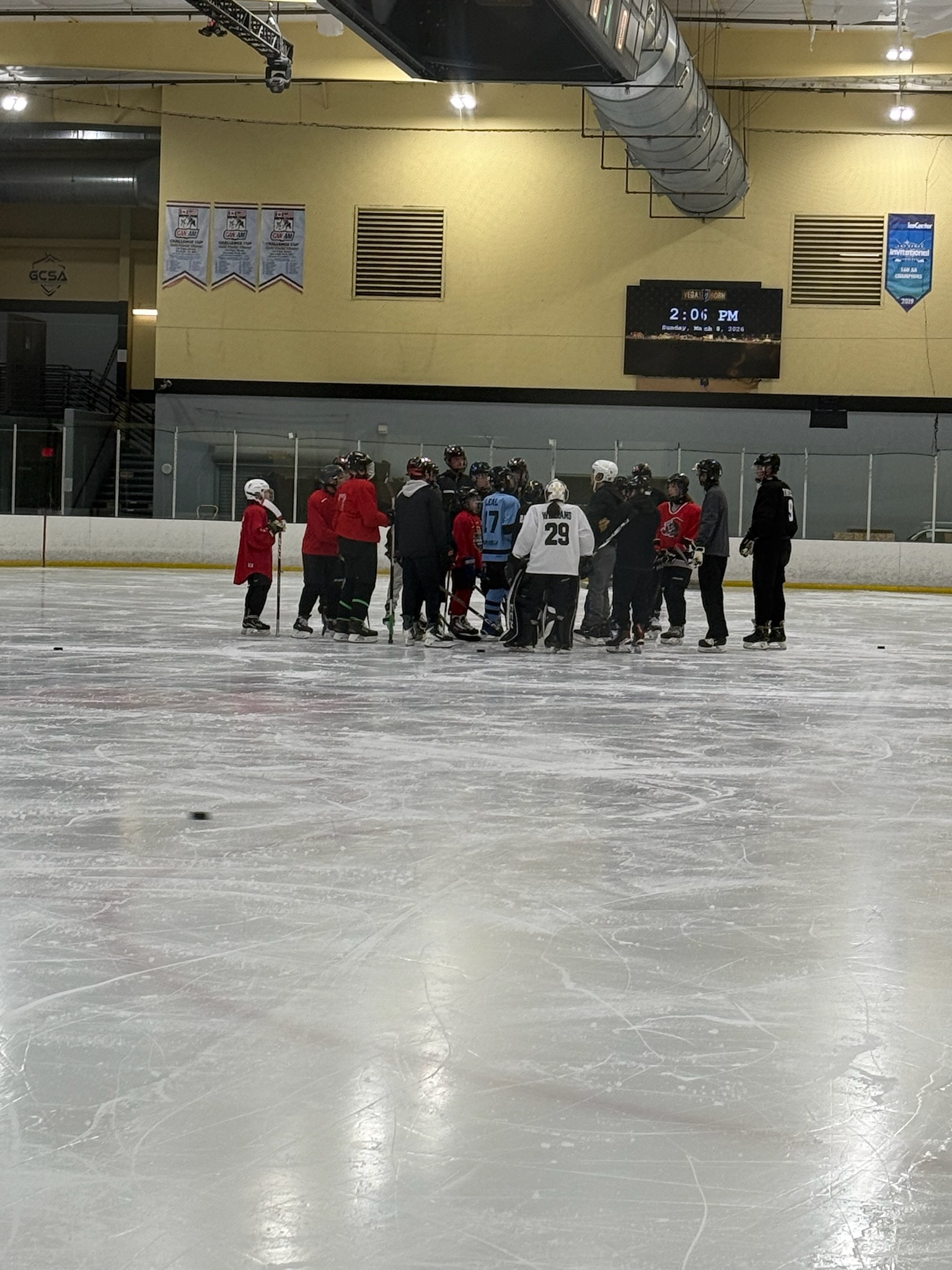
So much of what Adam and I talked about resonated with me as a former teacher. Adam even said to me at one point that his role feels less like coaching than it does teaching. Though I think to be good at either of those roles, you have to incorporate aspects of the other. All the best coaches impart on their players important lessons that carry over to other moments of their lives; all the best teachers provide a supportive and growth-oriented mindset, coaching their students through hardships and championing them as they succeed.
From the various strategies that Adam has been employing to the ways that he cares for each player, it’s clear to me that he is a natural teacher. Something else he told me reminded me of my own teaching experience: the way he sees the coaches, parents, and players as one cohesive unit. He makes an effort to greet the parents by name and makes time to meet with them and update them on how their child is doing. He encourages his assistant coaches to do the same. “These parents have so much to deal with. On a daily basis, they handle challenges I can’t even fathom,” Adam said. “I make a distinct effort to sit down with them when I can and compliment their efforts, talk about their kids, and just make them know that they are also a part of this.”
Between the diligent Board of Directors and Coach Adam, the Vegas Golden Chariots have had opportunities to get out into the community and interact with other teams. Later this month, on March 25th, the team will attend their second Autism Awareness Night with the Henderson Silver Knights and get to play a scrimmage at half-time. This awareness night is not only an excellent opportunity for the current players; it also opens the door for future recruits.
In April, the team is travelling to Anaheim, CA, to compete in a tournament against other NHL affiliate special needs teams. They will be playing teams from the Anaheim Ducks program, the L.A. Kings program, and several teams from Arizona. For this exciting event, the team was recently fitted for their first-ever official hockey sweaters. “They were really excited about the jerseys,” Adam laughed.
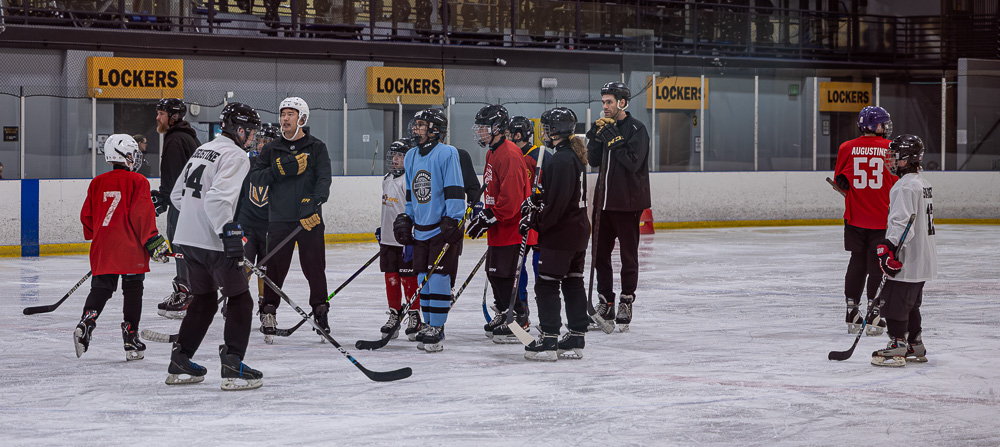
The thing that surprised me the most about all of this was that Adam only began his volunteer work (yes, you read that right—Adam does this for free) with the Golden Chariots in October 2025. So, this massive amount of progress has all been made in a five month period. Adam’s dedication and prior experience is partly to thank, but a big factor is that this team now has coaches that see them as they truly are: hockey players who deserve the same opportunity to learn and play that any other team would get. “You treat everyone well, you treat everyone with respect,” Adam remarked, “and it comes back to you tenfold.”
This open, gracious attitude has allowed the whole team to flourish. The impact can be seen not only in the progress the Golden Chariots are making but in Adam, as well.
“My friend was right,” Adam said. “This has changed my perspective on hockey. And more than anything, it’s brought us all back to the simple joy of the game. We’ve gotten back to the purity of the sport—just like the first times we ever played. We’re re-discovering the joy and excitement right alongside our players, and it’s a beautiful thing.”
Adam shared with me that the most important thing to him right now is getting the word out about the incredible hockey program he feels so privileged to be coaching. “I am just so proud of all my players, and I don’t want any of the attention—I want the players and parents to get as much of it as they possibly can. I’ve lived a blessed life without the challenges that they go through,” Adam said. “I remember a few times when teams I played for were spotlighted on the local news, and I felt so proud to see our name and picture. If we could manifest even a little bit of that for these players, that would be phenomenal. They deserve all the accolades and praise they can get. I’m so honored to be a part of their story and just want them all to know how truly incredible they are.”
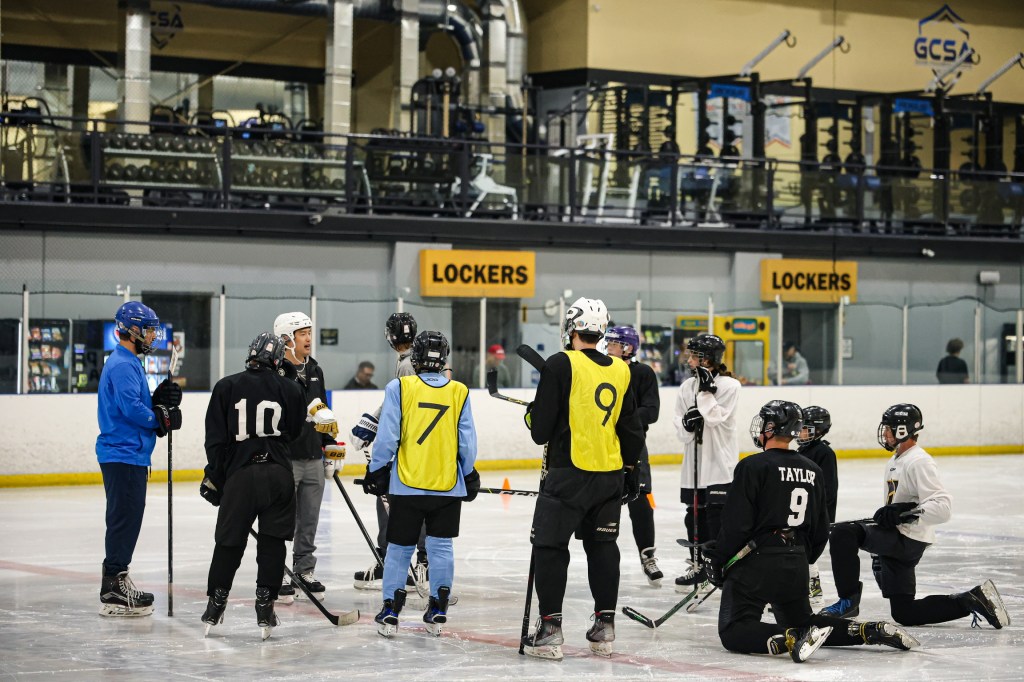
To follow the Vegas Golden Chariot program on Instagram, please visit @vgcspecialhockey
 The People Project
Leave a comment