Content Warning: This essay contains statistics and stories regarding women’s sexual health. If you are wary of or upset by mentions of issues such as infertility, sexual assault, miscarriage, abortion, illness, and sex, please be aware.
I thought I would begin the second part of this project with the first five questions of the survey. They are the first questions because I thought they were the most pertinent points of data to gather right off the bat: current age, age at first period, age at first sexual experience, number of sexual partners, and current marital status.
Let’s dive in.
What is your current age?
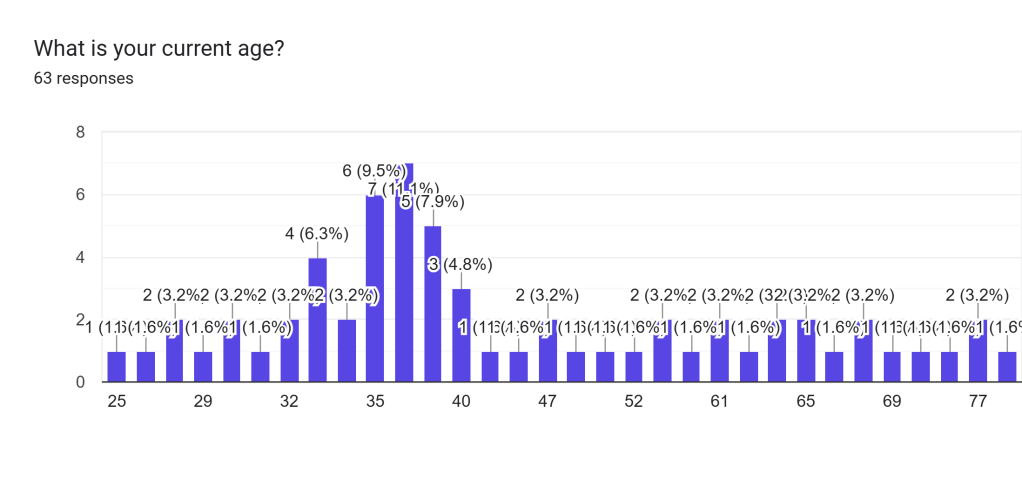
My 63 respondents had a pretty wide range of ages, though the average age lies somewhere in the mid to late 30s, as you can see from the above chart. This was not really a surprise since I am 36, and this survey was shared with many of my cousins, college and high school friends, and so on—most of whom are around my age, give or take a few years. The youngest participant was 25 and the oldest was 93. (This survey was anonymous, as I shared in the previous post and no personal information will be shared from any one respondent that could identify them, but since I only know one 93-year-old who still uses Facebook, that response wasn’t too much of a mystery. Thanks to my kickass great aunt for helping me out! Love you!)
Here is a basic age breakdown from highest population to lowest: 29 respondents were in their 30s; 11 respondents were in their 60s; 8 respondents in their 40s; 5 respondents in their 20s; 5 respondents in their 50s; 4 respondents in their 70s; and 1 respondent in their 90s.
At what age did you get your first period?
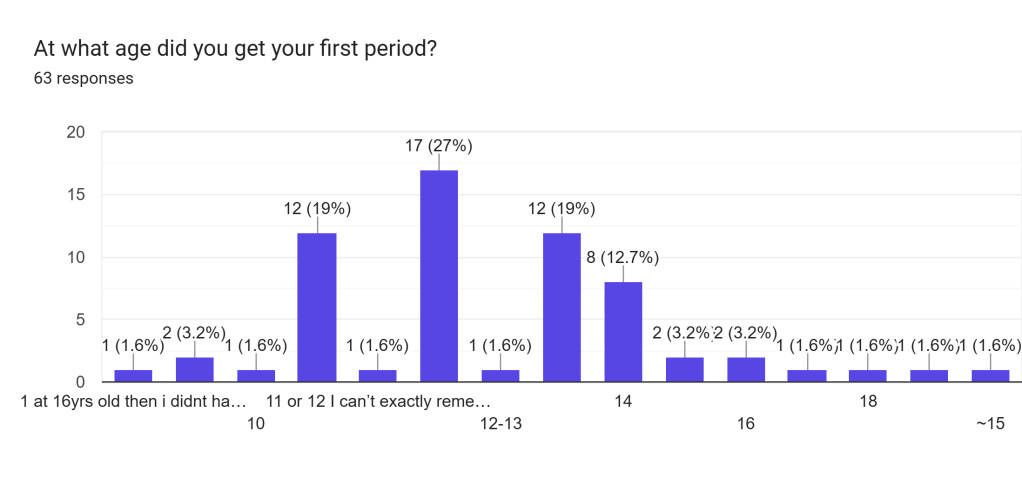
This graph is sort of wonky because some people responded with more than just an age. But, I have broken it down and grouped together like answers to make the results a little easier to understand:
- 18 participants responded that their first period came at age 12
- 13 responded age 11
- 12 responded age 13
- 8 responded age 14
- 3 responded age 15
- 3 responded age 16
- 2 responded age 9
- 1 responded age 10
- 1 responded age 17
- 1 responded age 18
- 1 responded that they could not remember
According to the Mayo Clinic, most girls get their periods between the ages of 10 and 16, with 98% of kids getting their first period by age 15, which my small subset of data reflects with 92% of my survey respondents (58 out of 63) falling in the age 10-16 timeline.
I remember very clearly the first time I got my period because it was both Friday the 13th and the last day of my middle school career. I’m not sure why, but I spent a lot of time in middle school thinking about getting my period, wondering if I was getting it, fantasizing that maybe I was having cramps or discharge or something, wearing pantiliners just in case, and listening to pretty much all of my friends yammer on about how they already had theirs and how annoying it was. I wanted to be annoyed, too!
It seemed like such a rite of passage, period-having. There was always a small piece of me that felt like an outsider among my peers which my lack of menstruation exacerbated. I think there were many reasons that I felt different or left out, most of which I couldn’t recognize or reconcile until adulthood and lots of therapy, but not having my “monthly visit from Aunt Rose” alongside my friends felt like a particular sort of pubescent punishment that I could not escape.
My mom would tell me that it was okay that I didn’t have it yet and I should be grateful because I had no idea what was coming for me down the line, but I still felt exceptionally immature and excluded. One day she told me that she was sure I would get it by the end of middle school and asked me just to be patient. Insert giant preteen eyeroll and sigh of exasperation that only a thirteen year old can feel when talking to their mom, even (or especially) when they know their mom is right.
So, I had gotten all the way to the end of eighth grade. It was over. Done. “Graduated.” It’s summer now, whoopee, two months until high school, and still no period.
The evening I came home from my last day of middle school ever (thank God for small mercies at least) and was preparing for the big celebratory eighth grade dance that evening—our for real last hurrah as middle schoolers—I felt something sort of weird in my underpants. So, I went to the bathroom, and there it was: several small streaks of menstrual blood in my purple Limited Too bikini-cut cotton panties. I. Was. Ecstatic. My mom was right, I did get it before middle school was completely over. Just in the nick of time.
I called my friend Emily to tell her and by the time I got to the dance, our whole friend group knew about it. I remember my pal Sara (you guys know her as the incredible political blogger whose profile I featured in April) lifting me up in the air and saying, “You’re a woman now!” I was pretty thoroughly embarrassed. But also proud, and relieved, to finally be part of the period club.
I have many times since wished I could revoke my membership but that is a story for a different time.
At what age did you lose your virginity?
According to the CDC’s most recent National Survey of Family Growth conducted between 2015 and 2019 by their National Center for Health Statistics, the mean age of first sexual intercourse for women is about 17.3. According to this same source, “By age 15, 21% of young females aged 15–24 had ever had sexual intercourse. By age 17, this increased to 53% of young females, and by age 20, 79% of young females had ever had sexual intercourse.” (NSFG, CDC, published 2020)
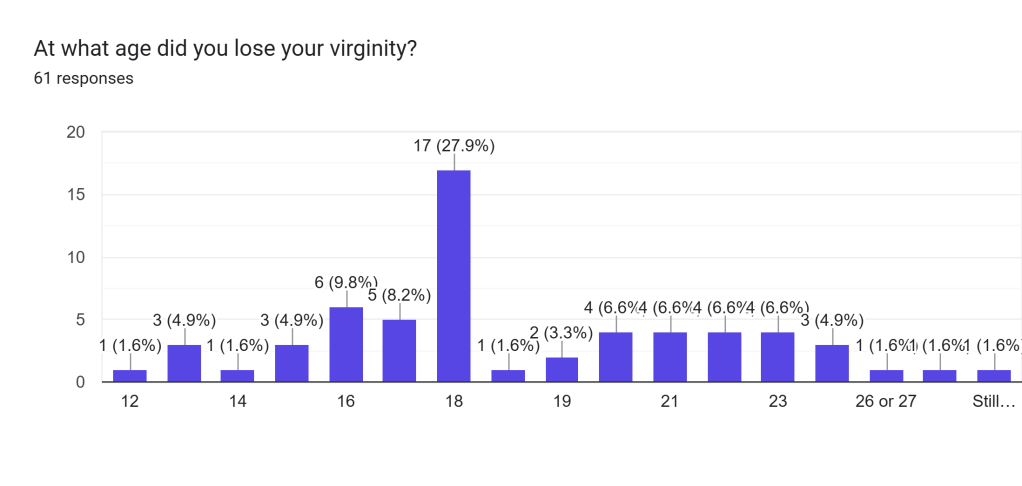
My survey more or less reflects this trend, though because of the small number of participants and the fact that several respondents chose not to answer this question, the percentages aren’t quite as high. When calculating the percentages from my survey, I excluded 3 responses: two that chose not to answer and one who responded that they were still a virgin. Of the 60 people who responded with age at first intercourse, 13% replied that first intercourse occurred at or by age 15; 31% replied at or by age 17; and 71% replied at or by age 20. As you can see from the above bar graph, a large number of my survey respondents stated that their first sexual intercourse happened at age 18. Here is the survey breakdown.
From the 60 respondents who provided an age: 18 respondents replied to having their first intercourse at age 18; 6 responded age 16; 5 at age 17; 4 at age 20; 4 at age 21; 4 at age 22; 4 at age 23; 3 at age 13; 3 at age 15; 3 at age 24; 2 at age 19; 1 at age 12; 1 at age 14; 1 at age 26; 1 at age 28.
Though my survey did not specify this, and so it is possible that some survey respondents were referring to homosexual encounters, sexual assault, or non-penetrative intercourse, I am assuming that most of these responses are indicating age at “loss of virginity” in reference to vaginal, heterosexual, and consentual intercourse. Clearly, I do not know this for sure but am making an assumption based on what I know about the general population that received this survey. (Again, this is a very non-scientific assumption and should this survey be performed in a more empirical, less biased manner, one would need to know the precise details of each respondent’s answer.) Please take no offense if you happened to answer this question and one of the above factors applies. My findings are in no way perfect or exact and the idea of “losing your virginity” can vary from person to person. The data from the CDC that I used above applies to heterosexual vaginal intercourse, and it is unclear whether their numbers for this particular measurement included or excluded consent as a factor.
Wherever you happen to fall in the timeline, these numbers are pretty validating, I think. Women have long been made to feel shame about their sexual identities and activity. I would imagine, knowing a little about how women think, that some of the respondents who replied an age like 12, 13, or 14 may have at some time in their lives been made to feel or called things like “loose,” “easy,” or even “slut” regardless of circumstance or their own feelings and interpretations of their sexual history. And then you have the women who it would seem were fully adults, who reported first sex at 21 or older (17 of my survey respondents reported this) who may possibly have felt like they were late bloomers or been called things like “frigid,” “cock-tease,” or “prude” for electing not to be sexually active until their 20s. Clearly, none of these labels are kind, fair, or true—women’s sexuality as well as women’s choice of how, when, and with whom to engage in sexual intercourse is an incredibly personal decision and regardless of age or circumstance, I believe that no woman should ever be made to feel less than based on how early or how late they have chosen to embark on sexual intimacy. I also suspect, guided by personal experience, that even women whose responses fell more in the “norm,” with ages between 15 and 20, may have felt shame or confusion around their first sexual experiences. We live in a culture apt to label women as slutty, prudish, or any other number of crude, gendered epithets regardless of the path they choose. There is a long-standing tradition in women’s healthcare and societal treatment that unfairly punishes women for whatever they do.
There’s a great Kacey Musgraves song called “Follow Your Arrow” that outlines this dichotomy in a lyrically excellent way with a catchy country twang. Check it out to see what I mean.
My own experience aligns pretty closely with what my survey found; I was also 18 when I officially “lost my virginity.” It would be many years until I became more comfortable with the idea of sex and sexuality and could feel mostly secure about my choices and experiences, but when I first had sex, I certainly felt a lot of guilt and shame. Part of this was due to the fact that I had been raised Catholic and though I engaged in mostly harmless fooling around with boys I dated in high school, I sort of still hung on to the idea that I might “save myself” for marriage or at least for the right person.
I think at the time, I thought I had chosen the right person to be my first but it very quickly became clear that I had been wrong. My first time happened about three or four weeks into college when my boyfriend from home, who was a year older and a sophomore at another university sort of far away, came to visit my college for a long weekend. I really thought I loved this guy but I am less sure now if it was real love or simply a whirlwind infatuation. We had been dating for about three months, and he had been quietly but pretty incessantly applying pressure for us to have sex for most of our relationship. We had gotten pretty close a few times, but I still really wasn’t sure I was ready. When he came to visit me that weekend, and my roommate had graciously gone to sleep over with a friend so we could have some time to ourselves, I ended up just giving in. I wasn’t physically coerced in any way, but it wasn’t what I truly wanted either. Like many women, I am sure, my first time was painful, not terribly fun, and immediately after, while my satisfied beau was deeply asleep, I lay awake full of regret and confusion.
About three weeks after that visit, I went to his college during my fall break. We had sex twice while I was there and I still didn’t find it particularly thrilling. About a week to ten days after visiting him, he broke up with me on the phone, citing the distance as well as a blossoming relationship with one of the girls in his a capella group. So, less than a month after I had decided to “share my precious gift” with this schmuck, he threw it in the trash, likely in exchange for a partner who he didn’t have to convince so much and/or didn’t have to wait weeks at a time to fuck.
I had a lot of guilt, shame, embarrassment, anger, resentment, regret, you name it over all this for quite a while after. As I mentioned before, I now have a pretty drastically different viewpoint on sex and virginity, for many reasons, but I also totally understand why 18-year-old me felt this way. He had betrayed me, and quite possibly, I had betrayed myself. After this experience, I essentially committed to “re-virginize” myself until I was really ready. That plan got fucked, too, but more on that in the part of this essay regarding sexual violence and harassment.
I now firmly believe that the overall societal messages we provide young women with about sex and virginity are pretty much all wrong. I think it’s in incredibly bad taste for anyone to make women feel shame for choosing to use their body in whatever ways they want to do it. I do think young women need to be better educated and supported around these topics, though I do not think a conversation with a teen girl who may be considering sex should involve words like “precious gift,” “save yourself,” “soulmate,” “wait for marriage,” etc. I am sure many people would disagree with me on this but I am pretty firm in this stance. I think teen girls, at home and in sexual education settings, should be made aware of all the risks including physical, mental, and emotional health consequences and should have the opportunity to hear other women’s stories about their sexual experiences, good and bad. At no time should a young woman hear messages of guilt or shame around this. Are caution, sexual health, and full consent huge considerations? Yes. Is listening to and trusting your own body and your own mind and heart a huge consideration? Yes. Should a teen girl ever be made to feel that a scarlet S—for slut, for soiled, for sexual, for shamed—be pinned to their lapel if they make a certain choice? No, never. We are already far too good at doing that to ourselves and don’t need society piling harmful messages on top of whatever complex emotions we may be harboring.
I am, of course, not advocating here for preteen and teen girls to be encouraged to go have sex willy nilly or even, at all. What I am advocating for is a total paradigm shift in how we talk to women, especially young and impressionable women, about sexual health, consent, hormones and puberty, choice, safety, and potential sexual consequences. Without this, no matter what they do, I believe girls and women will continue to feel confusion, guilt, and shame around sex whether they’re having it or not.
About how many sexual partners have you had? None, only one, 2-5, 6-12, 13-20, more than 20, unclear
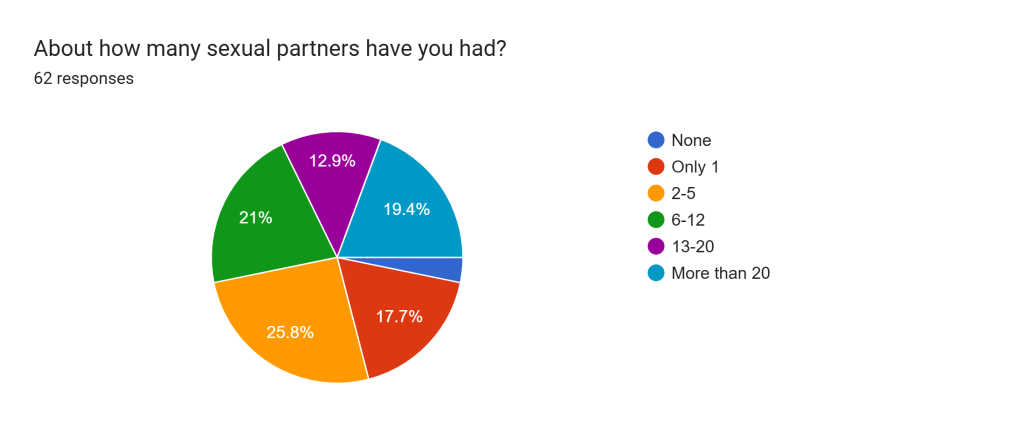
The data from this question surprised me a little bit, but it primarily trends with national data provided by the most recent NSFG. According to CDC data collected between 2015 and 2019, women ages 25 to 49 are most likely to have an average of about 4.3 sexual partners. (This statistic refers to partners over a period of time, not necessarily multiple partners at any one time.) The percentages they provide hold at just over 29% of women in this age range having had 2-4 partners; 28.5% having 5-9 partners; 17.5% percent having 1 partner; almost 13% having 15 or more partners; 11.5% having 10-14 partners; and no data for women in this age range reporting no partners.
Though I used slightly different ranges, the results from my survey seem to mostly align with the CDC data, at least in as much as which ranges received the most responses. As you can see from the pie chart, almost 26% (16 women) answered that they have had 2-5 partners; 21% (13 women) reported 6-12; about 19.5% (12 women) reported more than 20; almost 18% (11 women) reported only 1; almost 13% (8 women) reported 13-20; and about 3% (2 women) reported none. One respondent left the question blank.
This is not a statistic where I am going to share my exact personal data as I don’t think anyone wants to read a detailed account of all my sexual partners, especially not my parents, great aunt, or mother-in-law who all subscribe to this blog. I will say though, that I am among relatively good company, and anyone who knows me well enough to ask me personally and would like to know my “number” is free to ask anytime. If you are my father, you may be lied to.
I found these statistics intriguing and also comforting. If that sounds weird to you, let me elaborate.
Much like the age of first sexual experience, I think the number of people one has had intercourse with is a deeply personal and variable detail. Some women may not count sexual partners and therefore, may not know exactly. Some women may not know because of substance use (legal or otherwise.) Some may include unwanted sexual encounters or assaults in their count (I personally, do not) and some women may count all the various people they have had any kind of romantic or intimate encounter with, even if it did not include penetrative vaginal sex. There really isn’t a right way to calculate this and whether or not a woman chooses to calculate it at all is completely up to her.
I found the survey results intriguing because I think I assumed more people would answer in higher numbers. Not because I have a lot of promiscuous friends, but because we live in a more sex positive day and age, and I think it is relatively common for middle class, educated women to have had multiple sexual partners by the time they are around my age. To be fair, though yes (sorry dad) I have had multiple sex partners throughout my life, I have had only one sex partner for a while because my husband and I have been together for about eight and a half years and will have been married for five this June. And yes, while my survey did show that most of the women who responded have had multiple partners, I was still a little surprised that the highest count came back as the 2-5 range. In the heyday of Tinder, Hinge, and Bumble, I really thought a lot of my female friends and acquaintances might be raking it in, ya know?
But, I found the results oddly comforting as well, for two primary reasons. First, to support what I said in the previous paragraph; I do not appear to be the only one who has had multiple partners throughout my life—49 respondents answered that they had somewhere in between 2 and 20+ partners. Whether or not they continue to sow their wild oats or have since settled down with one partner, it is clear that many women have had varied sexual experiences. As someone who is pro female empowerment, I think that this statistic may reveal that women are acting in line with their desires and personal goals, rather than adhering to age-old admonishments about when, how, why, where, or with whom they should intimately engage. For some women, that might look like waiting until marriage and having one solid sexual partner for all of their life; and for other women, that might look like having sex with multiple, perhaps even many, partners until they settle down—or don’t .
I also felt a strange sense of awe and comfort from the 13 women who responded to this survey that said they had only had 1 sexual partner (11) or had not had any (2.) Though I am about as feminist as one can get and tend to try to eschew the romanticized and largely sexist notions painted by the likes of Mattel, Jane Austen, and Disney movies, I still find the idea of finding “the one and only” and sticking with them til death do you part, sort of sweet. I was encouraged by both the idea of women in my circles leading unafraid, sex-positive lives and by women in my circles waiting for and monogamously standing by one lifetime sexual partner. Marriage is hard and though many people commit to it or desire to commit to it down the road, there are a lot of different paths women can take to get there. It’s also not for everyone.
I want to tell you, whoever you are and whatever decisions you have made about your body and your relationships: it’s okay. If it’s right for you, it’s okay. Some women may think 20+ partners is obscene; some women may think “My God, I could never live with one dick for my entire life.” And those are BOTH okay. Society is so quick to tell women what to do with their bodies and lives, and I would like to encourage all women, regardless of what your personal choices may be, to avoid holding women who choose differently than you in contempt. Men, the patriarchy, historical ideas of a woman’s place in society, religious ideas and doctrines that attempt to hold sway over women’s bodies, even the current fucking administration and government will all attempt to demean, discourage, victimize, and vilify women without any help from us. So, please, ladies—stop the shame, the condescension, the dismay and revulsion against your sisters. You don’t know her whole story or why she does what she does. It doesn’t matter if something that works for her may never work for you. People are entitled to make their own choices and live their lives in ways that fulfill and satisfy them and no matter what, to consistently be treated with dignity and respect. She’s not always going to get that from the world but good gosh darn, she should get it from you. And me. And all her sisters.
What is your current marital status? Single, partnered but unmarried, married, divorced, widowed, other
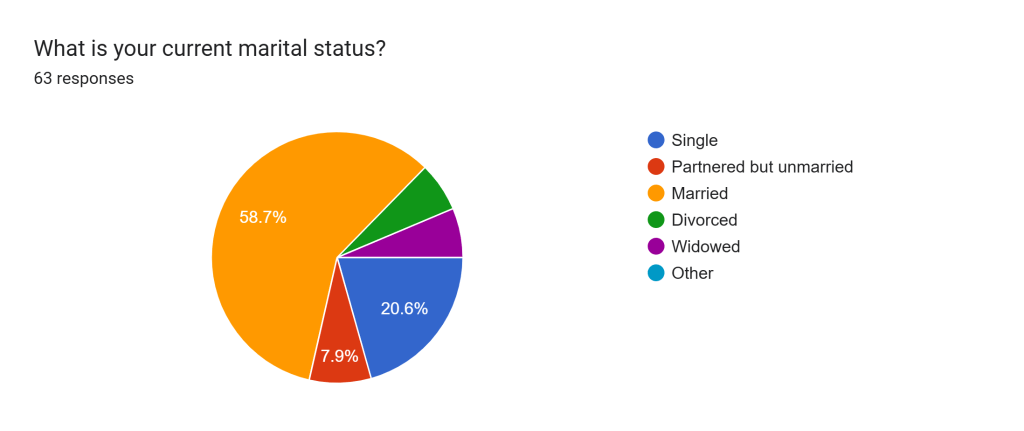
As you can see from this pie chart, a little more than half of my respondents are married. Which, if you refer to the first question about age, makes a lot of sense. 53 out of the 63 respondents were in their 30s through 60s, which is often where you find many married women. According to a 2025 article published by USA Facts, which is a site that provides various data on American issues using government sources including census data, the average marrying age for an American female in 2024 was 28.8 years old. As I did not ask when people got married in my survey, we only know what ages of women respondents are currently married.
All 63 respondents answered this question. 37 women replied married; 13 women replied single; 5 replied partnered but unmarried; 4 replied divorced; and 4 replied widowed. My survey only asked about current marital status so the number of women who are currently married, partnered, or single but may have been widowed or divorced in the past is not known. Again, as many of the questions on this survey reflect, this answer is variable and up to personal interpretation by each respondent, so it is by no means scientifically accurate.
Below is a fascinating chart tracking the rate of divorced and widowed Americans, comparing data from 1950 and 2024, that I found on USA Facts (which boy howdy, if you want your own rabbit hole to spend way too much time on, check it out—it has so many crazy interesting facts for little geeks like me.)
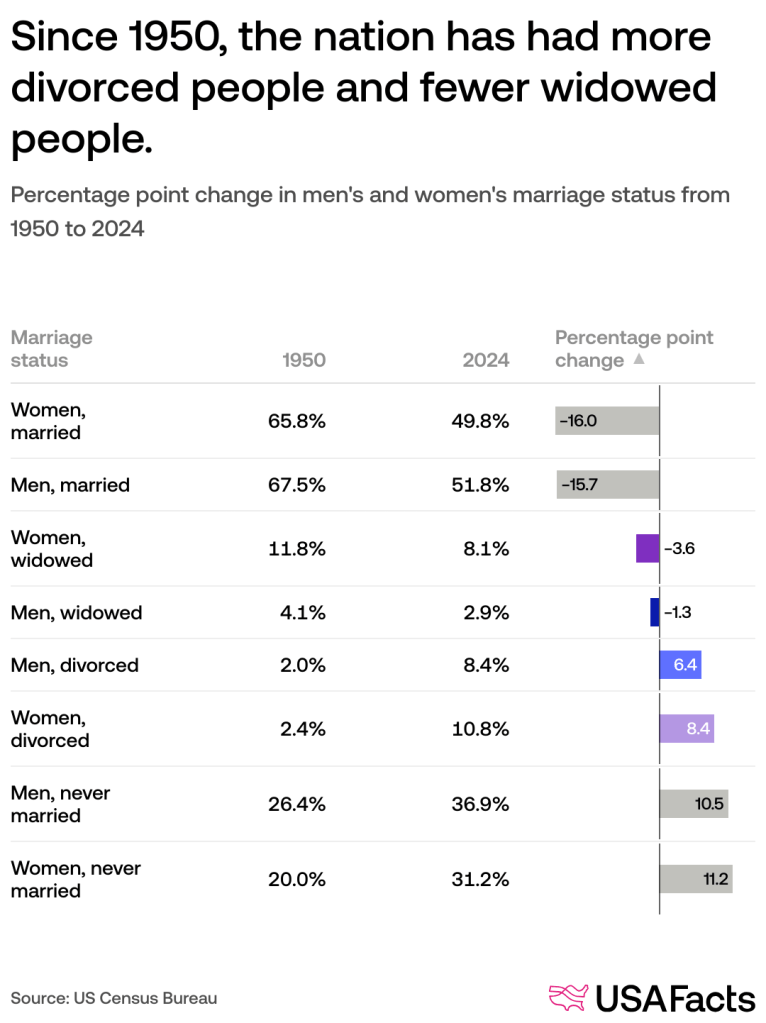
I think these statistics are really telling—not specifically about how marriages have ended over time, but more so about two specific points: American health and medical advances and women’s liberation and how women’s options and opportunities have changed and expanded over the last eight decades.
The fact that more women are widowed than men proves that we are not only the dominant sex (obvi) but also that advances in health and medicine have been and continue to be made to extend longevity. More women were always widowed than men, as you can see from the data in both 1950 and 2024, but less women and men are widowed today than 75 years ago which, I think, speaks to the fact that both sexes are living longer. Men often die sooner than women which remains consistent in the two data sets, but the fact that those numbers have dropped overall says a lot about the strides that people of both genders have made when it comes to general health and wellness.
The divorce rates, for both men and women, have grown substantially since 1950, as have the number of men and women who never married. To me, these data points speak to the expansion of opportunities and options for women. Divorce is a much less taboo and socially shunned concept than it was in 1950. One could claim that some people even divorce too casually nowadays, but whether or not that is the case, it is clear that people are exiting undesirable marriages in a more sustainable and socially acceptable way than several generations ago. The fact that the number of never married men and women has also grown relatively substantially and the rates of married men and women have declined in similar substantive quantities, may show that marriage is much more of a thoughtful choice in modern times than simply the expected and often dictated way of life for all respectable citizens, as it was considered in our not so distant history.
I think that all these data points show that people, but women in particular, have made great medical, cultural, psychological, and moral shifts in the last 75 years. Our way of living, relating, and thinking has changed and will continue to. Women are living longer, seeking and prioritizing new opportunities, keeping their relational options open longer or indefinitely, are making important decisions about the types of relationships they no longer want to be in, and in general are moving about our world in much more liberated, independent, care-affirming, and self-actualizing ways. To me, this says progress.
And personally, I can’t wait to see how much more progress my ladies will continue to make.
Resources to check out:
USA Facts Marriage data: https://usafacts.org/articles/state-relationships-marriages-and-living-alone-us/
USA Facts main page: https://usafacts.org/
CDC National Survey of Family Growth: https://www.cdc.gov/nchs/nsfg/index.htm
Mayo Clinic article about menarche: https://mcpress.mayoclinic.org/parenting/signs-your-child-is-about-to-start-their-first-period/


Leave a comment